

#9. The Hierarchy of Progress
 Tags:
conceptproductivity
Tags:
conceptproductivity
 Date Published: 2026-03-22
What is it?
Just like Maslow's hierarchy of needs, the hierarchy of progress is a blueprint for what to do to achieve your goals, brick by brick, just like building a house.
It consists of 5 parts:
- Physiology
- Environment
- Information
- Action
- Achievement
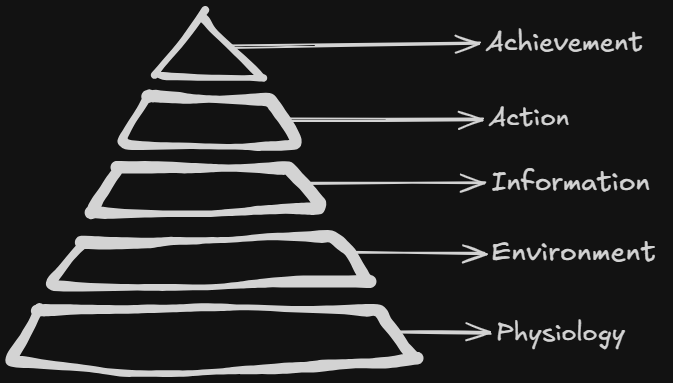
If you follow these parts, you will undoubtedly get to the top of the pyramid.
The foundation for high achievement is physiology.
Physiology is the scientific study of functions and mechanisms in a living system. In humans, it is the study of how the body works when you're healthy, and when you're not. [^1]
This is why it is the foundation of everything. There's a reason why the saying 'health is wealth' is universally true. If you're sick, your body and mind diverts all resources to curing you.
To achieve your goals, you need consistent work. To do consistent work, you need a consistently healthy body.
Good nutrition, a daily exercise regiment, and quality, consistent, and sufficient sleep have been repeated a million times, but many people still choose to ignore these daily aspects of physical health. Add to that journaling, meditating, and any other mental exercise, and your body and mind will be able to work at full capacity for you.
A good body requires a good environment.
The space around you and the people around you are conducive to your very being.
Surrounding yourself with junk, discarded clothes, and unused items will clutter your mind.
Surrounding yourself with low-quality people will, in turn, debase your own quality.
Be eternally conscious of who and what you surround yourself with. The human mind is like a boat on a river. You must steer it gently, lest you capsize.
To do consistent work, you need clarity and peace of mind. That is why a clean and organized environment is the second part and foundational to the next.
Make the distinction between relevant and irrelevant information.
Without sufficient information, you cannot act. The keyword here being sufficient.
There is such a thing as procrastination by gathering too much information.
Reading books, listening to podcasts, watching videos, are all great ways of learning in their own ways. The key is knowing when to stop, and take action with the information you have gathered thus far.
As a real world example, Rob is an exercise beginner who wants to go to the gym.
Relevant information (the bare minimum he needs to know in order to start) consists of:
- What gyms are the best in his area;
- How much they cost;
- Good exercises to do for which muscles;
- What weekly split he will follow for good recovery;
Note: nutrition and sleep should already be at a good level, as per the foundation of the pyramid.
Irrelevant information (the optimizations that he will accrue while doing the act) consists of:
- Very specific workout regiments;
- Very specific sets and reps, based on individual exercises;
- The best warmup routine;
- The best recovery routine;
- And thousands more...
Action.
Do the one most important action that will move you toward your goal the most, as soon as possible. Frequent failure is encouraged, and looked upon fondly by the true winners of the world.
The top of the pyramid.
In truth, the top is not really a step like others, more like a goal post. To be at the top of the pyramid is to achieve your goal, however large or time-consuming it might have been.
Here, it is important to be proud of yourself, but maintain humility. Deep introspection, hard work, but also, lots of luck. You may have good genetics for health, or enough money to afford a clean, spacious environment, or just more time.
Fortune plays an important role in our lives and is able break the whole pyramid in a single moment. It is a good person that works in spite of Fortune, but none thrive without her.